
IE OCL OBHPA/6/1/2
·
Item
·
1937-1939
Parte de Records of Offaly Board of Health and Public Assistance
4322 resultados com objetos digitais
Mostrar resultados com objetos digitais
IE OCL OBHPA/6/1/5
·
Item
·
1941-1942
Parte de Records of Offaly Board of Health and Public Assistance
IE OCL OBHPA/6/3
·
Subsérie
·
1935-1948
Parte de Records of Offaly Board of Health and Public Assistance
Volumes recording details of patients admitted to the County Hospital. Data recorded in each volume varies slightly but mainly includes:
Admission Number
Previous Number if any
Date of admission or birth
Name of inmate
Age/Sex
Description (Married, Single, etc.) or 'If adult whether single, married, widow or widower; if child, whether orphan, deserted, illegitimate or legitimate'
Religious Denomination,
Residence immediately prior to admission
Name and address of nearest relative and degree of relationship
Employment or Calling
No of dependents
Disease or other cause rendering admission necessary
Who gave recommendation for admission
Date of discharge or death.
IE OCL OBHPA/6/3/2
·
Item
·
1938-1941
Parte de Records of Offaly Board of Health and Public Assistance
IE OCL OBHPA/6/3/3
·
Item
·
1941-1948
Parte de Records of Offaly Board of Health and Public Assistance
IE OCL OBHPA/6/4/4
·
Item
·
1950
Parte de Records of Offaly Board of Health and Public Assistance
Statistical register categorising the type of patients admitted to hospital in order to estimate dietary needs. Details recorded include:
HEALTHY INMATES
Class 1 and Class 1a. Males and Females not working
Weak and Infirm Cases (M/F)
Class IV and IVa Infirm Men and Women
Boys and Girls 8-15 years
Boys and Girls 3-8 years
Infants (Over 2 and under 3; Over 1 and under 2; under 1 year)
TOTAL SICK
Adults of either sex above 15 years
Boys and girls 8-15
Boys and girls 3-8
Infants under 3
STATISTICS
Remaining in house last night
Admitted before breakfast
Discharged before breakfast
Admitted before dinner
Discharged before dinner
Remaining for dinner
Admitted before supper
Discharged before supper
Total of healthy as classed this night
Male Lunatics
Female Lunatics
Nursing mothers
Infirmary
Fever Hospital
IE OCL OBHPA/7/3
·
Item
·
1954-1957
Parte de Records of Offaly Board of Health and Public Assistance
IE OCL OBHPA/8/1
·
Item
·
1913-1947
Parte de Records of Offaly Board of Health and Public Assistance
Register recording deaths in the workhouse (1913-1921) and the county home and hospital (1922-1947) in one continuous volume of entries. On the closure of the workhouse in 1921, the register template was amended from 'Workhouse' to 'Offaly County Hospital and Central Home' to finally 'Offaly County Hospital and Home'. Details recorded include:
Number in register
Date and Place of death
Name and Surname
Sex
Condition (Married, bachelor, widow, etc)
Age last birthday
Rank, profession or occupation
When [death] registered
Sem título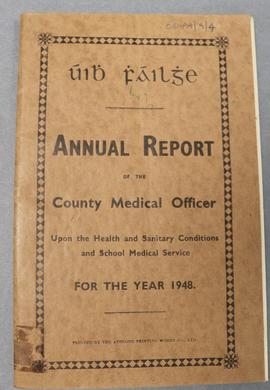
IE OCL OBHPA/9
·
Séries
·
1929
Parte de Records of Offaly Board of Health and Public Assistance
Series of annual reports with many gaps, compiled by the County Medical Officer of Health. The first extant report from 1929 focuses mainly on statistics gathered from inspections of the the national schools in the county. Topics covered include dental health, ophthalmic clinics, tonsil and adenoid operations, enlarged cervical glands, 'mental defectives', tuberculosis, malnutrition, vaccination, skin diseases, defective speech, rheumatism, deformities, open-air education, co-operation of parents, sanitation and environment of schools,
Later annual reports refer to the health and sanitary conditions in the county as a whole while also incorporating the school medical service report. This broadened report contains general statistics of the county, vital statistics, water and sewage reports, housing, lists of midwives, notification of births, notifications of infectious disease, diptheria immunisation, sanitary administration, food and drug samples, venereal disease scheme, school meals free milk scheme, welfare of the blind, district nursing associations, meat and milk inspections, bovine T. B. and the annual report of the clinical tuberculosis officer.
IE OH OHS1/1/2
·
Item
·
February - October 1912
Parte de Records of Rogers & Co. Solicitors
Routine outgoing letters, some badly faded and illegible. Approximately 1000 letters averaging 1 per page.
Includes letter to Secretary, Estate Commissioners, Dublin concerning Estate of Lady Bury Record No E. C. 8423: 'I am obliged for yours of the 23rd inst. and I note that the Commissioners are in communication with the Vendor's solicitors. If I may say so, I think it would be most advisable that the Commissioners would be in full possession of the local facts and circumstances from this point of view also. I think this would most likely facilitate a free solution of the questions that must be arising. The Commissioners may not be aware for example that the tenant of the large grass farm in the Croghan District is most willing to sell his interest, and as a matter of fact at the present time I am in communication with the tenant's representative with a view of finding out the lowest figure at which the tenant's interest can be acquired. It would be a thousand pities to let the opportunity pass of acquiring this land to relieve the frightful conditions of some of the Congested Tenants. I should be glad on behalf of the tenants, accompanied by one or two of the local clergymen to wait on you at any time to discuss the matter as I rather think the matter would be very useful.' (26 February 1912)