
Tullamore Incident

Área de elementos

Taxonomía

Código

Nota(s) sobre el alcance

  • The Tullamore Incident refers to a breach of law and order on 20 March 1916 in Tullamore, Co. Offaly. It is frequently referred to as 'the first shots of the Rising' although it occured a month before the Easter Rebellion. A large crowd of locals whose family members were in the British army gathered outside the Gaelic League Rooms in Columcille St. protesting against the Irish Volunteers. Shots were fired by Volunteers Peadar Bracken, Frank O'Brennan and Joe Wrafter. RIC Sergeant Ahern was injured by Bracken. 12 men were subsequently charged in relation to the incident.

Nota(s) sobre el origen

    Mostrar nota(s)

      Términos jerárquicos

      Tullamore Incident

      Término General Historical events

      Tullamore Incident

        Términos equivalentes

        Tullamore Incident

          Términos asociados

          Tullamore Incident

            16 Descripción archivística resultados para Tullamore Incident

            16 resultados directamente relacionados Excluir términos relacionados
            Papers of the O’Brennan Family
            IE OCL P77 · Fondo · 1873-1955

            Contains manuscript material, brochures, pamphlets, and a substantial newspaper collection created principally by Tullamore brothers and Irish Volunteers Séamus and Alo O’Brennan. The earliest material from 1906 and 1909 are programs for feiseanna held by Tullamore Celtic Literary Society and Conradh na Gaeilge. Also includes letter from Inspector Crane of Tullamore RIC Barracks giving permission in 1911 to James Brennan (Séamus O’Brennan) to play hand-ball in the alley at the barracks during weekdays. Both Crane and O’Brennan were involved in the Tullamore Incident five years later.

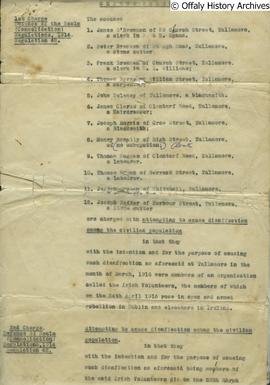
            Also includes a copy of the charge sheet relating to the Tullamore Incident of March 1916, the original of which is in a related set of O'Brenan family papers. This copy is annotated by Alo O’Brennan, along with annotated pages from Hansard’s Debates from April 1916 relating to the ‘affray.’

            Also includes an illustrated pledge signed by Alo O’Brennan in Tullamore in June 1918 ‘denying the right of the British government to enforce compulsory service...’

            Also includes an autograph book created by Séamus O’Brennan in Ballykinlar internment camp (1920-21).

            Sin título
            O'Brennan Family Papers
            IE OH OHS31 · Colección · 1911-2015

            Material relating to Tullamore Incident, March 1916 and the 1916 Rising from the family of Séamus O'Brennan and his brother Alo O' Brennan. Contains postcards, photographs, contemporary newspapers (1916-1917), memoirs, and commemorative newspapers (1966).

            Sin título
            Scrapbook
            IE OH OHS31/B/4 · Unidad documental simple · 1966
            Parte de O'Brennan Family Papers

            Scrapbook of newspaper cuttings, culled from the 1966 Jubilee publication by The Midland Tribune and other newspapers. Mainly relates to Offaly's participation in the period 1914-1916, particularly focussing on the Tullamore Incident. Contains a 'Partial list of the Boys from Tullamore and its environs that took part in the Fight for Irish Freedom.' Also lists the 'pioneers of the first Gaelic Society in Tullamore: Patrick F. O'Loughlin, Donal O'Connor, Thomas Barry, Richard Barry, Gerald O'Loughlin, John Forrestal, Patrick McLoughlin, Hugh Digan, Denis Davin, Thomas Moroney, Harry Ruxton, Jospeh Aylemers and James Pyke.

            Sin título
            Letterbook 1916
            IE OH OHS1/1/7 · Unidad documental simple · January 1916-June 1916
            Parte de Records of Rogers & Co. Solicitors

            Copies of approximately 1000 outgoing letters, averaging 1 per page. Good legibility.
            Includes many references to the Tullamore 'affray' or Tullamore Incident, for example, letter to Tim M. Healy, M. P, House of Commons: '...I was immediately concerned with giving the facts in support of the point that the Competent Military Authority - Martial Law and the Defence of the Realm Regulations notwithstanding - noted without lawful authority in taking the prisoners out of Tullamore Gaol, that he has them illegally in his custody, and that the proposed trial by Court Martial will be illegal. ...It is entirely a case for a civil tribunal - for a jury; and on the evidence it is extremely unlikely that a jury anywhere would convict. It had not the most remote connection with the "Rising"; and to drag these men and boys before a Court of Military officers steeped in the atmosphere of the Insurrection and trotted out on the rebel stage a grave injustice - and is putting prisoners in serious danger.' (23 May 1916)