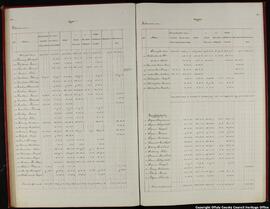
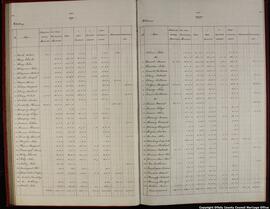
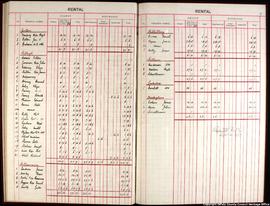
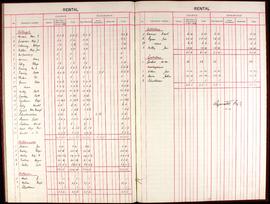
Killurin

Zone des éléments

Référentiel

Code

Note(s) sur la portée et contenu

    Note(s) sur la source

      Note(s) d'affichage

        Termes hiérarchiques

        Killurin

        Terme générique Geashill (Bar.)

        Killurin

          Termes équivalents

          Killurin

          • Employé pour Killurine

          Termes associés

          Killurin

            112 Description archivistique résultats pour Killurin

            112 résultats directement liés Exclure les termes spécifiques
            Annual Report 1859
            IE OCCHO DIGBY/A/3 · Pièce · 1859
            Fait partie de Digby Irish Estates

            Annual report for year ending July 1859, including a list of leasholders and undertenants who have surrendered their several leases; general account of income and expenditure; detailed statements of disbursements including costs of drainage and building improvements; a list for compensation for surrender of tenancies and emigration; and a detailed rental of entire estate.

            Contains a summary report outlining the mechanism of the leaseholder's compensation fund, the distribution of which, W. S. Trench describes as 'the most arduous and most serious task of responsibility I have ever had to encounter.' Also discusses estate improvements such as the drainage of 125 statute acres, particularly in Meelaghans where 100 acres 'of miserable cut away bog' was drained and cultivated. Also discusses improvements to the labourers' cottages through the additions of chimneys and windows and a proposal to enter the new cottages for the award of the Gold Medal offered by the Royal Agricultural Society. Further estate improvements include new roads through Killellery, Lugmore and Meelaghans.

            Agrarian unrest is also discussed in the context of the case of Henry Kane, tenant, who along with his brother, Michael Kane, each held a farm in Killurin. On the death of Michael, Henry took immediate posssession of his brother's farm, to which the Trenchs objected. Report discusses general tenant support for Kane, even from outside the estate, and includes descriptions of intimidatory tactics by Ribbonmen. Also discusses measures to have Henry Kane ejected from the land altogether.

            Drawings in the report include:
            Page 2: 'Ancient pan found on Geashill Estate, 4 feet broad x 14 inches deep' (The Geashill Cauldron)
            Page 11: 'Ancient keg of butter found 12ft below surface of Red Bog. 2 feet long x 13 inches broad.'

            Digby Estate Valuation and Survey
            IE OCL P74 · collection · 1798-1799

            Survey and valuation of the Digby estate completed by Michael Cuddehy, land surveyor, for Lord Digby, on 3 January 1798 and a further valuation on 25 June 1799 listing lands in the barony of Geashill that are out of lease. Townlands surveyed in the initial valuation are listed in Cuddehy's accompanying note as Annaharvey, Ballymooney, Ballyknockan, Ballycue and Ballyduff, although only those of Ballycue and Ballyduff are extant. The valuation is tabular, listing tenants' names, a description of their holdings (e.g. 'moory pasture', 'oat field', 'big fallow field' etc.), a measurement in A.R.P (acres, roods, perches) and a yearly value.

            The second list entitled 'Lands in the Barony of Geashill out of lease except the parts disposed of as herein 25 June 1799' contain a list of the townlands Annaharvey, Ballymooney, Ballycue, Bluebell, Ballyduff , Dalgan, Ballydownan, Curragh, Killellery, Ballyavill, Cappincur, Kinockballyboy, Ballinagar, Killleigh, Scrub, Killeenmore, and Killurin. Each description is accompanied by a reference number for a map by Cuddehy which is not extant. There are also comments by Cuddehy on certain plots such as 'Darby Smollen declared tenant' in respect of a plot in Ballydownan and he notes that Cuddehy himself is proposed for a plot in Ballymooney of 149 acres.

            Sans titre
            Annual Report 1865
            IE OCCHO DIGBY/A/9 · Pièce · 1865
            Fait partie de Digby Irish Estates

            Annual report for year ending 1865 containing details of the rental of the estate and the slow recovery of the financial situation. Describes the low level of emigration from the estate in comparison to the rest of Ireland. Also describes drainage and land improvements at Ballyknockan, Ballycollin and Annagharvey, and at the new farm known as 'The Prairie.' Reports on tillage of corn and the sowing of grain, rape, grass-seed and potatoes.

            Reports on the transformation of the village of Killeigh from a state where peripheral houses had already fallen in and the houses on the main street had become too dangerous and too exposed to the weather to live in, to newly built cottages which were entered for competition of Gold Medal of the Royal Agricultural Society of Ireland for the best cottages in the province of Leinster and also won the challenge cup offered by the Duke of Leinster. Other buildings include a new house for the miller at Killeigh and Odlum of Ballymooney required extensive additions to his premises. A long range of offices were built for Mr Denning in Cappancur and a new forge was built in Ballinagar.

            Also reports on the clearance of Clonad Woods and the purchase of an interest in a considerable plantation in Ballydownan. Regarding threats from Ribbonmen, the report states that Killurin is now the only part of the estate subject to outrages, chiefly of the robberies of foresters of the estate. Also reports that emigration rates have fallen and only sons and daughters of small farmers are leaving for America to join other family members.

            Annual Report 1868
            IE OCCHO DIGBY/A/12 · Pièce · 1868
            Fait partie de Digby Irish Estates

            Annual report and rental for year end June 1868, containing details of the finances of the estate, and developments inn drainage, land improvement, waste farms, tillage, woods and plantations. Main drains were completed at Meelaghans and Ballinvally, and 'thoro' drains were completed at Ballyknockan, Ballymooney and Killurin. All the drainage schemes were entered into a competition offered by the Royal Agricultural Society of Ireland for best drained land. Discusses farming and the merits of various types of fertilizer: Dublin manure, woolen rags or bone-dust. Also reports on the construction of a movable 'Russian Village', as seen at the Paris Exhibition in 1867, for easily housing labourers as they move around to work on various parts of the estate.

            Reports that a new building yard has been acquired next to the house of the architect, Thomas Mallinson, in Geashill Village, and also that a new machinery shed has been constructed to house the steam-engine, the threshing mill and other implements. In relation to repairs to tenants' houses, the report outlines there is much yet to be done, but that Lord Digby has won the gold medal from the RASI for repairs in the best manner for the greatest number of houses in Leinster. He was also awarded a bronze medal at the Paris Exhibition of 1867 for models of cottages exhibited.

            Discussing the general condition of the estate, Trench notes that the 'slight stains of Fenianism have been washed away by time and people now look at it as a thing of the past.' He also notes the death of the 3rd Earl of Rosse, the Lord Lieutenant of King's County, 'celebrated for his monster telescope and scientific acquirements.' Appendix contains a copy letter from Thomas Mallinson, Geashill architect, to T. W. Trench, reporting on a visit to London to inspect the manufacture and use of concrete to build houses. Declines to recommend concrete-built houses for the Geashill estate due to the expense and the varied character of the houses.

            Annual Report 1872
            IE OCCHO DIGBY/A/16 · Pièce · 1872
            Fait partie de Digby Irish Estates

            Annual report and rental for year end June 1872, reporting a very satisfactory financial situation and an overview of receipts and disbursements on the estate. Notes that drainage and land improvements continued but that there was an increased difficulty in sourcing labourers. Main drains were completed at Killurin and Gorteen, and a thorough drain was built at Bawnmore. Reports that sums were expended on extensive fencing and top-dressing of lands. The village inn was completely remodelled and 'now forms one of the most striking features of the village.' Also report that the woods and plantations were more profitable than usual with a large contract won for the supply of ash timber to a Liverpool merchant. Oak and larch plantations were established on the land between the River Clodiagh and the new embankment. Describes the general condition of the estate as 'most satisfactory' and entirely free from violence and lawlessness. Notes, however, that Mr Flanagan, a tenant, disputed the right of Lord Digby to his property but failed at his attempt in doing so.

            Roskeen rentals are missing from this volume in order to combine the accounts of the Geashill and Roskeen estates into one. They will appear in subsequent annual reports. John Townsend Trench signs for his father, William S. Trench, who may have already passed away (August 1872) by the time the report was submitted.