Killeigh
140 Descrição arquivística resultados para Killeigh
Annual report and rental for year end June 1867, containing reports on the continuously improving financial situation of the estate, due mainly to the increase in rental receipts. Also reports on drainage at Ballyknockan and the remarkable effect of Dublin dairy manure has had on the land in this area. Other farming improvements include the invention and introduction by Trench of a new drainage plough which was given special merit by the Royal Agricultural Society of Ireland. Further farm machinery was also purchased such as a mowing machine and a hay-tedder which were hired out by the farmers of the estate.
Reports that building and slating has increased all over the estate and provides a description of various building repairs and a newly-built farmhouse let to the Commons family - 'one of the oldest and most respectable families on the estate.' Also reports that four new labourers' cottages built in Killeigh for people whose houses were in ruins, were awarded the Gold Medal and Challenge Cup by the Royal Agricultural Society of Ireland. Also refers to the sale of timber to the Great Southern & Western Railway, which allowed for a large portion of Derryclure to be thinned of beech and replanted with larch and oak, and also necessitated the purchase of a weighing machine for timber to avoid the tolls of the weighbridge in Tullamore.
Referring to past agrarian outrages, Trench remarks that the tone on the estate is 'excellent' and 'it is as if Fenianism never existed'.
Lease of part of the lands of Killeigh from Edward Earl Digby to Willaim Owen Handy Esq. for two lives, or twenty-one years from 25 March 1818.
Including 'A map of part of the lands of Killeigh in the Barony of Geashill and King's County. Part of the Estate of the Right Honourable Earl Digby. Surveyed by John Molloy 1818', hand coloured, scale 20 Perches to an Inch, with bordering land leased to Richard Hargrove.
Lease of part of the land of Killeigh Pigeonhouse, Ballinvally and Scrubb Wood from Edward Earl Digby to Michael Conroy for three lives or 31 years at a yearly rent of £157-3-7.
Tenancy agreements with monthly rents for holdings in Geashill and in Killeigh.
Rent and rates book between Lord Digby and Mr Foy for lands in Killeigh.
Original incoming and copy outgoing correspondence concerning aspects of estate management undertaken by A. & L. Goodbody, solicitors on behalf of Lord Digby, such as correspondence with the Irish Land Commission involving the valuation; inspection and sale of the estate; legitimacy of land ownership; rental arrears; payment receipts; the transfer of Geashill National School; employee salaries; and estate repairs.
Includes letter from Goodbody to Digby: ‘…The Michael Dunne the Inspector means lives with his sister on a 15 acre farm P.L.V. £6 and had 4 cattle. Perhaps you can identify him. The reason who these allottees are asked to raise representation is because the personal representative has to agree to consolidate the plots they are getting with the land they already have. We can ask the Commissioners to waive the consolidation, but cannot anticipate whether they will or not. This may delay matters…’ (1 December 1927)
Handwritten letter from James Chissell to Lord Digby: ‘Received from Messrs A. & L. Goodbody the sum of two hundred pounds, that being the amount of compensation given to me by Lord Digby in consideration of the land taken from me by the Estates Commissioners, for purpose of relieving congestion on the Geashill Estate.’ (23 August 1927)
Letter from Goodbody to Digby: ‘…Then in regard to Reggie’s letter, which I return to you. He knows his own mind very well and as he made you the offer I should advise you to abide by it. I wrote him recently about the National Roman Catholic School at Geashill. It was originally built by your family and vested in the Educational Commissioners at the nominal rent of 1/- and now our mutual acquaintance the Reverend Father Phelan has asked me to vest it free of charge in the Trustees of the Roman Catholic Church.’ (15 July 1927)
Original incoming and copy outgoing correspondence relating to the administration of the Geashill Estate. Matters referred to include complications in the of sale of Scrubb Wood to A. E. Morean of Borrisokane due to the death duty on timber owed by Digby; applications for licenses from the Forestry Department to fell trees during wartime; emergency powers (control of timber) order 1941; trespass and poaching; offer of sale of Derrygunnigan wood to the Forestry Division, Department of Lands; wartime food supplies; and rental arrears.
Includes letter from Digby to Kennedy: ' I am absolutely at a loss to make out how you make out that duty was not paid on the Irish property and the woods. I am sure it was; the valuation included the woods as far as I can remember. When I have sold the woods before no question of this has arisen & I don't want this raised now. In fact if there is any quotation of it, the whole matter of the sale in this manner should be held up and the sale carried out similar to the Derrygunnigan sale or not at all. This raises such a big question that I should prefer to have no sale rather than a letter should go anywhere near the authorities on this subject. What action have you taken? You don't say whether you have raised the matter through the London solicitors or tried to do it direct. Please do nothing of this kind in future without writing to me on the subject.' (27 October 1940)
Includes letter from Kenneth Robins, stonemason, Portarlington to Kennedy: 'Looking at the ruins of the Digby Estate in Geashill the other day. I would like to know if their representatives would sell the pieces of cut stone in and around the site? I would buy and take away any stone suitable to my trade.' (2 February 1942)
Includes letter from G. Muir, forester on Digby Estate to Mr Douglas (Of A & L Goodbody): 'I am sending you this note as Mr K may be at Court top let you know that we have had the devil's own fire on Derryadd. It has been a night & day job since 11 last night until 11 today and now we have got to put out the fire in Derrynasligue Ditch or bank, and a half of a long road to carry water. Damn bogs anyway, they may be the glory of Eire but any way a curse to me.' (7 May 1942)
Includes letter from Kennedy to Digby:'We are all keeping well but as you say housekeeping is becoming increasingly difficult. We are really fortunate living in the country and cannot very well starve as I have been able to produce an acre of potatoes, and we have plenty of our own milk and eggs, and I have also produced 35 barrells of oats off two statute acres not to mention a very adequate supply of good turf (not off the two acres!). Unfortunate people especially of the poorer class in Dublin and other cities must be in a bad way. (19 September 1942)

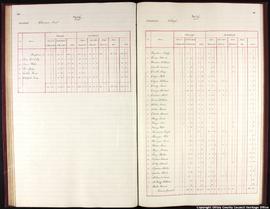
Sem títuloIntroductory report submitted by Trench to Lord Digby, following his arrival on the estate on 1 June 1857. He notes that he spent the first three weeks with his son, T. W. Trench, in Tullamore, and assessed the estate on horseback during this period. Report contains a general sketch of the natural features of the estate; the extent of arable pasture, plantations or bog; the issue of rent collection and methods of valuation; and a survey of the woodlands and their ownership. A post script to the report begins on page 48 and contains further commentary on the state and extent of schooling in the area; use of the Union Workhouse; the levels of pauperism and general notes on the cottier class of tenantry. Also includes a list of current leaseholders on the estate.
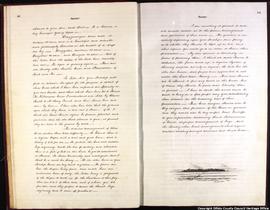
Trench sketched scenes from life on the estate over the following pages:
Page 6 Sketch of Old Irish Red Deer
Page 10 Sketch of Geashill National School
Page 20 Sketch of Geashill Village
Page 23 Sketch of Derrigunnigan Wood
Page 25 Sketch of Tullamore Road
Page 27 Diagram of bogland to be drained
Page 29 Sketch of Turf Bog Annagharvey depicting two men fighting with sticks.
Page 31 Sketch of Red Deer
Page 33 Sketch of Killeenmore Moors