Papers of the Lamb, Fuller, Johnston, Shaw, and Tobias families, and the members that were connected with Woodfield House.
UntitledRoll books, daily report books and corporal punishment books from Eglish National School.
UntitledContains manuscript material, brochures, pamphlets, and a substantial newspaper collection created principally by Tullamore brothers and Irish Volunteers Séamus and Alo O’Brennan. The earliest material from 1906 and 1909 are programs for feiseanna held by Tullamore Celtic Literary Society and Conradh na Gaeilge. Also includes letter from Inspector Crane of Tullamore RIC Barracks giving permission in 1911 to James Brennan (Séamus O’Brennan) to play hand-ball in the alley at the barracks during weekdays. Both Crane and O’Brennan were involved in the Tullamore Incident five years later.
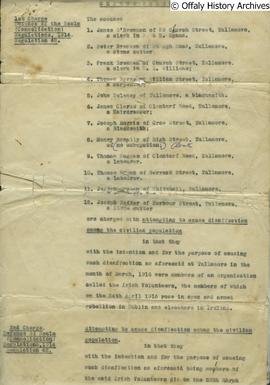
Also includes a copy of the charge sheet relating to the Tullamore Incident of March 1916, the original of which is in a related set of O'Brenan family papers. This copy is annotated by Alo O’Brennan, along with annotated pages from Hansard’s Debates from April 1916 relating to the ‘affray.’
Also includes an illustrated pledge signed by Alo O’Brennan in Tullamore in June 1918 ‘denying the right of the British government to enforce compulsory service...’
Also includes an autograph book created by Séamus O’Brennan in Ballykinlar internment camp (1920-21).
UntitledMinute books, accounts ledgers, reports, workhouse registers, and ancillary material relating to the creation, administration, and eventual dissolution of Parsonstown Union from its establishment in May 1839 to its dissolution in 1925. The union’s Board of Guardians were responsible for overseeing several functions of local government; primarily the care of the poor, including the setting up, financing and running of the workhouse, the creation of dispensary districts, assisted migration and outdoor relief.
The main set of records are the minute books of the Boards of Guardians, comprising 97 volumes. Other material is financial in nature, such as the financial minute books and repayment of relief account book. Three registers of the Parsonstown (Birr) workhouse survive; 1842-1843, 1849-1850 and loose pages from a 1912 registers. As the Board of Guardians also oversaw the dispensary districts in the union, there is a ledger relating to their activities, as well as a copy of the lease for the Kinnitty dispensary residences.
Parsonstown Union’s area of operation covered 234 square miles from two counties: from Offaly (King’s County) – Banagher, Drumcullen, Eglish, Ferbane, Frankfort, Kilcoleman, Kinnety, Lemanagan, Letter, Lusmagh, Seirkyrans, Parsonstown, Shannon Bridge, Shannon Harbour and Tissarin. From County Tipperary – Aglishcloghane, Ballingarry, Dorha, Lockeen, Lorha and Uskeane.

UntitledCorrespondence (1963-70), mainly between Swayne and W. H. Milner, Portarlington, relating to a film made by Fr. Kennedy in 1921 ostensibly on the turf-cutting industry in the area, but also features the exhumation of skulls of the ‘Ballynowlart Martyrs’ who were purportedly burned alive in Ballynowlart church by English forces in the 1600s. Correspondence culminates in the deposit of the film in the National Library of Ireland.
Offaly Sinn Féin material: original resolution from North and South Offaly Executive Sinn Féin signed by Comd. Ua Duinn relating to its support of the Treaty (29 December 1921) and calling on Offaly’s representative Dr McCartan to vote for ratification, and a pamphlet entitled 'Terms of Reference 23 May 1922 Adjourned Árd-Fheis of Sinn Féin'.
Leaflets and other printed material relating to Croghan Feis organised by Offaly Vocational Education Committee (1949).
Manuscripts notes on placenames and history of Killeigh Parish and Philipstown (Daingean).
Publications: Programme for Walsh Island Second National Turf-cutting competition (1935); Knockbeg Centenary Year Book (1948); and Suncroft, a Parish Magazine (1970).
UntitledTexts of legislation relating to factory conditions and terms of employment.
-
‘Textile Factories Factory and Workshop Act, 1878’ signed by R. G. For J. & L. F. Goodbody.
-
‘Textile Factory and Workshop Act 1901-1916’, signed by J. & L. F. Goodbody, Ltd., 5 September 1921.
-
‘Textile Factories factory and Workshop Acts 1901-1920’ signed by J. & L. F. Goodbody, Ltd., 23 March 1925.
-
‘Textile Factory and Workshop Act 1937’, signed by Harold J. Goodbody, August 1937.
Canvas-backed paper map of the former county town of Philipstown (Daingean) compiled by Arthur Richards Neville in June 1786 for Richard Nassau Molesworth, 4th Viscount Molesworth (1748-1793). The map covers 2887 statute acres and includes environs of the town. The plots are numbered 1-130 with an accompanying reference table describing the contents of each land-holding unit. The reference is tabular, listing tenants' name, description of the holdings (e.g. 'a very fine farm all good meadow', 'good high Meadow & Pasture', 'great red bog', 'poor ground' etc) a yearly value and a sum total of the east and south east side of Philipstown.
Scale 20 perch to the inch (1:5040)
UntitledAccount book for Charleville Castle containing weekly returns of income and expenditure for Charleville Castle from 1 January 1814 to June 1817. Income was principally derived from accounts in Newcomen's and other private banks. Expenditure consists mainly of payments to clothiers, builders and servants.
UntitledMaterial relating to Tullamore Incident, March 1916 and the 1916 Rising from the family of Séamus O'Brennan and his brother Alo O' Brennan. Contains postcards, photographs, contemporary newspapers (1916-1917), memoirs, and commemorative newspapers (1966).
UntitledInquest reports handwritten by James Dillon, King's County Coroner into a leather-bound notebook. Inquests begin at No. 589, 21 February 1846 and end at No. 1079, 12 December 1854. Format of inquest reports is largely identical beginning with a record of the inquest number, date, location of inquest and the name of the deceased. Then follows a list of the jurors present and witnesses called. The reports end with a verdict on the cause of death. Notable due to its date span which covers the famine era.
Untitled