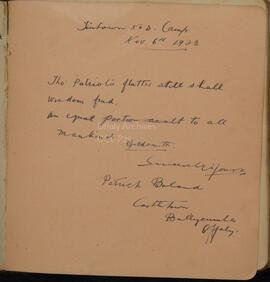
Quote from Oliver Goldsmith transcribed by Patrick Boland (Castletown, Ballycumber, Offaly), Tintown No 3 Camp
'The patriots flatter still shall wisdom find
An equal portion dealt to all mankind'
This website uses cookies to track the amount of users to our site. This is achieved through third party metrics (Google Analytics) More info : https://www.offalyarchives.com/index.php/privacy
UKAT
Terme spécifique 1798 Rebellion
Terme spécifique 1916 Rising
Terme spécifique Anglo-Irish Treaty 1921
Terme spécifique Ballynowlart Martyrs
Terme spécifique Battle of Vinegar Hill
Terme spécifique Crotty Schism
Terme spécifique Gaelic revival
Terme spécifique Gaelic Sunday
Terme spécifique Geashill Cattle Drive
Terme spécifique Irish Civil War
Terme spécifique Land War
Terme spécifique Ranch War
Terme spécifique The Emergency
Terme spécifique The Great Famine
Terme spécifique The South African War, 1899-1902
Terme spécifique The Truce
Terme spécifique Tullamore Incident
Terme spécifique War of Independence
Terme spécifique World War 1
Terme spécifique World War 2
Terme spécifique Young Irelander Rebellion
Quote from Oliver Goldsmith transcribed by Patrick Boland (Castletown, Ballycumber, Offaly), Tintown No 3 Camp
'The patriots flatter still shall wisdom find
An equal portion dealt to all mankind'
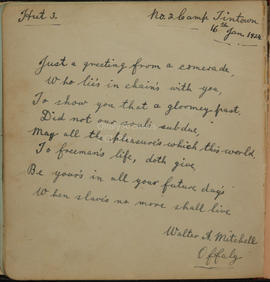
Verse transcribed by Walter A. Mitchell (Rahan, Offaly), Hut 3, Tintown No.2 Camp:
Just a greeting from a comrade
Who lies in chains with you
To show you that a gloomy past
Did not our souls subdue
May all the pleasures which this world
To freeman's life, doth give
Be yours in all your future days
When slaves no more shall live.'
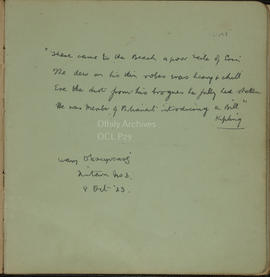
Quote from a parody of Thomas Campbell's 'The Exile of Erin' transcribed by Liam Ó [Dulchaointigh], Tintown No 3 Camp, who ascribes this version to Rudyard Kipling:
'There came to the beach a poor exile of Erin
the dew on his thin robes was heavy and chill
Ere the dust from his brogues he fully had shaken
He was Member of Parliament introducing a Bill.
Verse transcribed by Vincent Burke, Hut 12, No 3 Tintown camp:
'What is life?
Ah who can say!
Clouds upon a summer day
Gone tomorrow, here today
Gift of heaven come to stay
Who can say?
What is death
Ah no-one knows!
Words that cease and eyes that close
Something sweeter that repose
Just away that each one goes
Where God knows!
What is Love?
Ah who can tell!
Sometimes heaven, sometimes hell
Neither wholly ill or well
All would buy, but who can sell?
Who can tell?
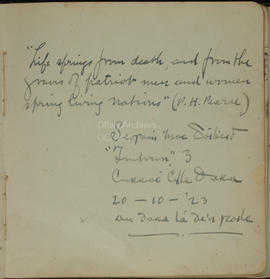
Quote by Patrick Pearse transcribed by Seosamh Mac Dáibhéid, Tintown No 3 Camp, on the second day of the [hunger] strike ('An dara lá de'n stailc'):
'Life springs from death, and from the graves of patriot men and women spring living nations.'
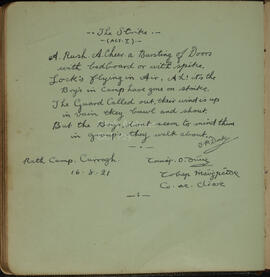
Verse by T. P. Duke transcribed by Tomás Ó Dúigh (Clare), Rath Camp:
'The Strike
Act 1
A rush. A cheer. A bursting of doors
with bedboard or with spike
Locks flying in Air, Ah! it's the
Boys in camp have gone on strike
The Guard called out their wind is up
in vain they bawl and shout
but the Boys don't seem to mind them
in groups they walk about.'
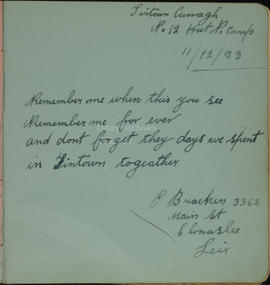
Verse transcribed by P. Bracken, Internee 3362 (Clonaslee, Laois), Hut 12, Tintown Camp:
'Remember me when this you see
Remember me forever
And don't forget the days we spent
in Tintown together'
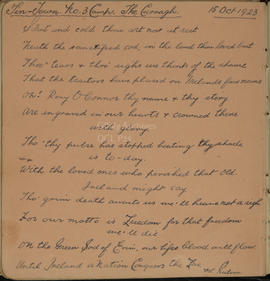
Verse transcribed by M. Galvin, Tintown No 3 Camp:
'Silent and cold thou art now at rest
'Neath the sanctified sod, in the land thou loved best
Thro' tears and thro' sighs we think of the same
That the traitors have placed on Ireland's fair name
Oh! Rory O Connor thy name and thy story
Are engraved in our hearts and crowned there with glory.
Tho' thy pulse has stopped beating thy shade is to-day
With the loved ones who perished that old
Ireland might say
Tho' grim death awaits us we'll have not a sigh
For our own motto is Freedom for that Freedom we'll die
On the green sod of Erin, our life's blood will flow
Until Ireland a nation conquers the foe.'
Contains manuscript material, brochures, pamphlets, and a substantial newspaper collection created principally by Tullamore brothers and Irish Volunteers Séamus and Alo O’Brennan. The earliest material from 1906 and 1909 are programs for feiseanna held by Tullamore Celtic Literary Society and Conradh na Gaeilge. Also includes letter from Inspector Crane of Tullamore RIC Barracks giving permission in 1911 to James Brennan (Séamus O’Brennan) to play hand-ball in the alley at the barracks during weekdays. Both Crane and O’Brennan were involved in the Tullamore Incident five years later.
Also includes a copy of the charge sheet relating to the Tullamore Incident of March 1916, the original of which is in a related set of O'Brenan family papers. This copy is annotated by Alo O’Brennan, along with annotated pages from Hansard’s Debates from April 1916 relating to the ‘affray.’
Also includes an illustrated pledge signed by Alo O’Brennan in Tullamore in June 1918 ‘denying the right of the British government to enforce compulsory service...’
Also includes an autograph book created by Séamus O’Brennan in Ballykinlar internment camp (1920-21).
Sans titreExtract from 'The Rebellion Handbook' compiled by 'The Weekly Irish times' published in 1917, featuring page 127 'Tullamore Prisoners Discharged'.