
Photocopy of letter from William Perkinson, Croghan, to his brother-in-law, John Monaghan, Lanervase County, Michigan, US. Describes financial difficulties of the family, the fall in value of family home and the great distress suffered in the locality. "There is no wonder made of death here". He writes also of his hope to emigrate to America.
UntitledEmigration
19 Archival description results for Emigration
Photocopy of letter from William Perkinson to John Monaghan, noting the 30 year acquaintance of the two, and enquiring about the welfare and whereabouts of Bernard Devan, a native of Croghan who emigrated to America, and known to Monaghan.
UntitledPhotocopy of letter from Mary Perkinson to John Monaghan, informing him of the family's impending eviction from their holding and pleading for assistance to emigrate to America. Describes Croghan and the impact of famine and emigration on the area: 'Most of your old neighbours are either dead or emigrated, most of the land was to growing grass, and strange to say the people are flying away in thousands yet. Nothing will keep them at home. Love of country or of kindred will not prevent them. Off they go and when will it end God only knows. Bad landlords is the cause.'
UntitledPhotocopy of letter from William Parkinson, Widnes, Lancashire, England to his cousin John Monaghan, thanking John for his letter and remarking that he had found his address in an old book of his father's, and remembers the correspondence of the previous generation. He asks after the Herrig and Dewan families originally from Cloghan who had emigrated many years previously. Repeats his intention to move to America and asks for assistance.
UntitledMinute books, accounts ledgers, reports, workhouse registers, and ancillary material relating to the creation, administration, and eventual dissolution of Parsonstown Union from its establishment in May 1839 to its dissolution in 1925. The union’s Board of Guardians were responsible for overseeing several functions of local government; primarily the care of the poor, including the setting up, financing and running of the workhouse, the creation of dispensary districts, assisted migration and outdoor relief.
The main set of records are the minute books of the Boards of Guardians, comprising 97 volumes. Other material is financial in nature, such as the financial minute books and repayment of relief account book. Three registers of the Parsonstown (Birr) workhouse survive; 1842-1843, 1849-1850 and loose pages from a 1912 registers. As the Board of Guardians also oversaw the dispensary districts in the union, there is a ledger relating to their activities, as well as a copy of the lease for the Kinnitty dispensary residences.
Parsonstown Union’s area of operation covered 234 square miles from two counties: from Offaly (King’s County) – Banagher, Drumcullen, Eglish, Ferbane, Frankfort, Kilcoleman, Kinnety, Lemanagan, Letter, Lusmagh, Seirkyrans, Parsonstown, Shannon Bridge, Shannon Harbour and Tissarin. From County Tipperary – Aglishcloghane, Ballingarry, Dorha, Lockeen, Lorha and Uskeane.
UntitledAnnual report for year ending June 1860 containing details of the leaseholder's compensation fund, the executors' arrears, mesne rates, new rentals and the purchase of leases. Also discusses estate improvements: permanent land improvement at Meelaghans; the creation of turf banks at Colehill; management of woods and plantations at Scrubb Wood, Killeenmore and Derryweelan ('Furry Hill'); and the building of roads and bridges at Clonad and Derryclure. Particularly refers to the 'model farm' which has been established at Ballyknockan.
In relation to the construction of houses, the report describes the completion of Richard Odlum's offices in Ballyduff, 'one of the most independent and thriving farmers on a large scale on the estate.' Also discusses Odlum's house in Ballymooney to be near completion. Reports that cottages in Killeigh and the new rent offices are complete 'and ought to last forever'. Referring to dire housing conditions amongst some of the tenantry, the report justifies the expense on rebuilding houses and states that there was more than one case on the estate 'where the inhabitants were in daily danger of being buried alive.' Also reports on small repairs to existing tenants' houses and a scheme of compensation for 59 families to surrender certain tenancies.
Also reports on agrarian unrest and agitation by Ribbonmen on the estate, including arson attacks on Geashill Castle offices and outhouses, and an arson attack on the farm of Mrs. Pattison, Protestant tenant at Annagharvey. Appendix contains copy letter from John Townsend Trench, second son of W. S. Trench, who interviewed Mary Shea, barmaid of the Cross Keys public house, Geashill, at the barracks in Tullamore where she was being held for her own safety. Letter describes plot to assassinate T. W. Trench and lists the main Ribbonmen active in Geashill as told to J. T. Trench: Loughlin Kelly ('treasurer of the murder fund'), Henry Bryan of Cross Keys public house; John Whelaghan, John Helian, William Grumly, Ned Geraghty, Christopher Mooney, Johnny Clibborn and others.
Drawing on pg 151:
Sign language or secret signals of the Ribbonmen
Annual report for year ending June 1861 containing details of executors' arrears, mesne rates, new rentals, estate improvements and general observations on the management of the estate. In terms of estate improvements, the report details drainage schemes including the completion of the reclamation of the land at Meelaghans and new schemes at Ballyknockan, and Ballina. Also includes details of roads built from Clonad to Derryfad and from Ballyknockan Bridge to Knockbally. Reports that the Royal Agricultural Society of Ireland awarded provincial prize of the gold medal to Lord Digby for the greatest number of improved cottages in the province of Leinster. Also reports on improvements to the Castle including the conversion of the old ball room to a parlour and drawing room.
Regarding the general management of the estate, Trench reports on 'improved tone and feeling' on the estate with new houses and improved layout appreciated by tenantry. Considers the area still backward in terms of agriculture but improving. Very dissatisfied with the police authorities in the district and reports that 6 murders took place in King's County, 2 of the most barbarous in Geashill. Also updates Lord Digby on the situation with Ribbonmen on the estate. Reports that eight active Ribbonmen have been ejected from the estate: Loughlin Kelly (Ballina), Henry Bryan (Cross Keys public house), John Clibborn (Clonmore), John Helian (Killurin), Darby Flanagan (Pigeonhouse), John Whelaghan (Newtown), Patrick Larkin (Colehill) and William Grumley (Dalgan).
Drawings in report:
Page 119 'Thoro or main drain' diagram
Page 120 Diagrams for drain and outlet for drains
Page 125 Diagrams of drains and thoro drainage
Page 129 Map of estate drainage
Annual report for year ending June 1862 containing details of the rental of the estate and the consequent worsening financial situation. Explains that rental income has decreased due to the inability of the tenants to meet their rent following the bad harvest of the previous year. Also discusses drainage and land improvements at Ballyknockan, Annagharvey, Ballyduff, Ballydownan and Colehill. In terms of buildings, the report discusses construction of a new school house at Geashill and minor repairs to existing tenants' houses. Referring to the number of tenants on the estate, the report suggests that there are too many for advantageous farming and discusses compensation scheme for emigration. Reports that 807 tenants have left in the last five years and 142 houses were levelled.
Referring to the threat from Ribbonmen, the report warns that Lord Digby is set to lose two of his best tenants, Mr Denning, bank manager of Bank of Ireland, Tullamore and Mr Dowling, attorney, Tullamore due to sustained intimidation by Ribbonmen. Appendix contains copies of letters from both men setting out their situation. Appendix also cotnains report on the woods and forests by forester Daniel Dewar.
Drawings in report:
Page 1 Drawing of cottage and yard with tenants and animals
Page 5 Drawing of large farmhouse with adjoining field being ploughed.
Page 8 Drawing of the new schoolhouse
Page 10 Drawing of Scrubb Wood before and after thinning
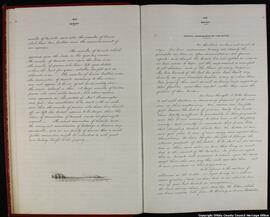
Page 12 Drawing of a ship sailing from the coast (emigration)
Page 105 Map of Ballycollin