Offaly (King's)

Taxonomía

Código

Nota(s) sobre el alcance

  • King's County reverted to County Offaly in 1920.

Nota(s) sobre el origen

    Mostrar nota(s)

      Términos jerárquicos

      Offaly (King's)

      Términos equivalentes

      Offaly (King's)

      • Usado para County Offaly

      • Usado para Co. Offaly

      • Usado para Uibh Fhaili

      • Usado para King's County

      Términos asociados

      Offaly (King's)

        18 Registro de autoridad resultados para Offaly (King's)

        1 resultados directamente relacionados Excluir términos relacionados
        Patrick Moore & Sons, Victuallers
        Entidad colectiva · c.1890 - 1960

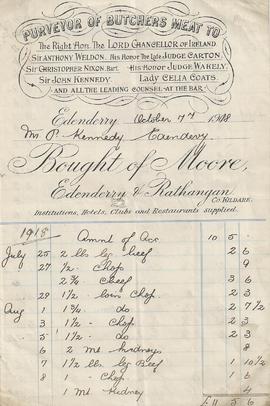
        Patrick Moore & Sons were a family run victuallers who supplied meat to many local people and businesses in the towns of Edenderry, County Offaly and Rathangan, County Kildare and many smaller towns in the surrounding area.

        Pattersons & Co. Ltd.
        Entidad colectiva · 1821-1970s

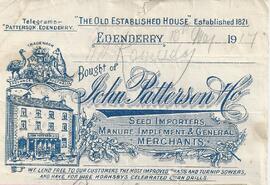
        Pattersons & Co. Ltd. traded at the Old Established House, J.K.L Street, Edenderry and consisted of a public house, a general provisions shop and an undertakers.

        Presbyterian Church, Birr
        Entidad colectiva · c.1839-

        The Presbyterian Church in Birr grew in numbers in the 1840s following the Crotty Schism. Fr William Crotty (with his cousin Fr Michael Crotty) led this breakaway Catholic congregation to join the Presbyterian Church. Crotty's Church built to emulate a Presbyterian Hall was erected in Castle Street in 1839. A new church building for the Presbyterian congregation was erected in 1885 in John's Mall, not now in use.

        Banagher Improvement Committee
        Entidad colectiva · 1890-1938

        The Banagher Improvement Committee was involved in the development of public housing, drainage and sanitation, local industries, electricity supply and street lightning, employment schemes, local infrastructure and the revival of Banagher Great Fair.

        Pepper, Thomas Ryder
        Persona · c.1760-1828

        Thomas Ryder Pepper married Anne Bloomfield, daughter of John Bloomfield and Anne Charlotte Waller. He lived at Loughton House which built in 1777 on lands owned by the Pepper family. The Pepper family lived at Loughton House until Thomas Pepper died as a result of a hunting accident. Thomas Pepper requested in his will that his brother-in-law, the 1st Lord Bloomfield, Benjamin Bloomfield, acquire Loughton House.

        King's County Infirmary
        Entidad colectiva · 1788-1921

        King’s County Infirmary was established under King George III’s reign with the passing of the Irish County Infirmaries Act of 1765. This act enabled the creation of infirmaries in thirty Irish counties. In an amending act from 1768, King’s County Infirmary was moved from Philipstown (Daingean) to Tullamore, the new county town. During the redevelopment of Tullamore town by the Earl of Charleville, a new infirmary building was erected in 1788 on Church Street and was further extended in 1812.

        The County Infirmaries Act was enacted to provide healthcare to the poor which fulfilled the eighteenth century philanthropic ideals of the landed gentry who supported these institutions through donations and subscriptions. King’s County Infirmary was supported by an income comprising of parliamentary funds, grand jury presentments, governor subscriptions, donations, and patient fees. The infirmary was managed by a Board of Governors who paid subscriptions for their position on the board. Governors had absolute control over the infirmary including staff appointments and patient admissions. To gain access to the infirmary, Governors issued tickets of admission which were most likely given to their employees, tenants, and servants. The governors who supported the hospital were made up of local gentry and landowners such as the Earl of Rosse, Lord Digby and prominent businessowners such as the Goodbody family.

        During the War of Independence, King’s County Infirmary came under the jurisdiction of the new Sinn Féin majority council, now renamed Offaly County Council. On the 21st of January 1921, the secretary to Offaly County Council attended a meeting of the board to inform them of the closure of the infirmary. It was to be closed under the Offaly amalgamation scheme whereby the workhouse hospital would become the new County Hospital. The board pleaded with the council to delay the closure in order to settle the affairs of the hospital in relation to critical patients and financial matters. The hospital eventually closed in August 1921 after it was reported by the surgeon and registrar to the board, that the bedding and beds were carried out of the infirmary by unknown persons suspected to be under orders of the county council.

        Following its closure, King’s County Infirmary accommodated the civil guards and then housed the county library until 1977. The façade of the original King’s County Infirmary can still be seen on Church Street, Tullamore, which has now been repurposed into apartments.

        Entidad colectiva · 1967-1982

        Birr Business and Professional Women’s Club was formed in the County Arms Hotel, in November 1967. It was the first business and professional women’s club to be formed in Ireland outside of Dublin.

        Cox, Ambrose Clement Wolseley
        Persona · 1845-1913

        Col. A.C. Wolseley Cox was the son of Ambrose Cox and Emily C. Wolseley. He was born in 1845 and inherited Clara House on the death of his father in 1863. He subsequently mortgaged the house and estate to fund his army career and his life in London. He married Louisa Helen Elizabeth Kirwan in 1870 and left a son, Reginald Garnett Wolseley Cox (1872-1904). Their Dublin residence at 41 Fitzwilliam Street is now known as the Fitzwilliam Townhouse. Col. Cox served as High Sherriff for King's County in 1873 but his income was insufficient to support his lifestyle and he was declared a bankrupt in 1888.

        Biddulph, Middleton Westenra, Lt Col
        Persona · 1849-1926

        Middleton Westenra Biddulph was born on 17 August 1849 at Rathrobin, Mountbolus, King’s County (Offaly). He was one of six children, and the eldest surviving son of Francis Marsh Biddulph (1802–1868) and Lucy Bickerstaff (d. 1896). She was born in Preston, Lancashire and they married in 1845. The Bickerstaff connection was to be an important one for the surviving sons of Francis Marsh Biddulph, and led to a substantial inheritance in the 1890s for Middleton W Biddulph, and his brother Assheton, who lived at Moneyguyneen, Kinnitty.
        The Biddulph ancestors were from Staffordshire, and later Wexford, and had arrived in King’s County from as early as 1694 or 1660. Lt Col. Biddulph held about 1,000 acres, of which perhaps 600 to 700 acres he farmed with the balance leased to his long-standing Protestant tenants. His landholding was principally in the townlands of Rathrobin and those adjoining of Clonseer, Cormeen, Kilmore and Mullaghcrohy, all near Mountbolus, in the civil parish of Killoughy and the barony of Ballyboy.

        Middleton Biddulph went to Foxcroft House boarding school in Portarlington, aged 11, thereafter to the Royal School in Banagher, and joined the army when he was eighteen, enlisting with the Northumberland Fusiliers (Fifth Regiment). Initially an ensign or cornet, he rose in the ranks quickly and was a Lieutenant by 1871, Captain in 1881 and Major from 1885. Before retirement in 1896 he held the rank of Lieutenant Colonel. He spoke French, German and Hindustani and stations included: Hythe March (1872), St Helier’s, Chatham (1879) Portsmouth (1881), Agra (1880), Mullingar (1882), Newcastle (1886), Colchester (1887) and Aldershot (1891). It was while he was at Mullingar with the Ist Batt. Northumberland Fusiliers that he was appointed adjutant of the Ist Northumberland and ordered to proceed to Alnwick. It appears that he met his future wife, Vera Flower, following on from an introduction by her brother Stanley Smyth Flower (1871–1946), who was also an officer in the Royal Northumberland Fusiliers. They married in 1891. Vera Josephine Flower was a daughter of Sir William Flower, Director of the British Museum of Natural History, South Kensington, London. They did not have children.

        When Biddulph retired from the army in the mid-1890s, he returned to Rathrobin and rebuilt the old house with the benefit of the Bickerstaff inheritance over the period 1898 to 1900. He employed Sir Thomas Drew as architect and William Beckett of Dublin as the builder. Once the new Rathrobin House was completed, Lt Col. Middleton Biddulph got on with his duties as a landlord and was a regular attender at the Petty Sessions, the Board of Guardians, and the County Infirmary, served as High Sheriff in 1901, and was appointed Deputy Lieutenant of the County in 1910. He was also on the board of the King’s County Joint Committee for Technical Instruction and the King’s County Farming Society. He and his wife left for England in June 1921 as the military campaign of the IRA in the locality intensified, and Rathrobin House was destroyed by Republican IRA forces in April 1923. While he seemed to have planned to return to Ireland after this, an attack on his land agent, Violet Magan, and his own declining health delayed plans to do so, and he died in Chelsea in May 1926.

        McGinn's Bakery
        Entidad colectiva · 1920-1996

        The premises were first mentioned in a lease from Charles William Bury to John Shaw in 1790. It became a brewery in 1805 when Richard Deverell acquired the property. The ownership changed again, i.e. to George Wilkinson, a baker, in the 1850s.
        Michael McGinn (1879-1973) bought the premises in 1920 from the widow Brophy under whose ownership a pub was run by the Keeney family. McGinn was from Mountmellick and managed a D. E. Williams grocery shop there before he bought the pub in Tullamore. He continued the pub trade and also operated a bakery and a grocery on the premises. The licence was transferred in 1967 to his son Philip McGinn who renovated the pub in 1978 and changed the grocery part to an off-licence in 1980.