Ballymooney

Elements area

Taxonomy

Code

Scope note(s)

    Source note(s)

      Display note(s)

        Hierarchical terms

        Ballymooney

        Ballymooney

          Equivalent terms

          Ballymooney

            Associated terms

            Ballymooney

              49 Archival description results for Ballymooney

              49 results directly related Exclude narrower terms
              IE OCL P74 · Fonds · 1798-1799

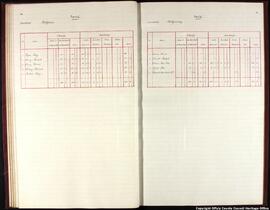
              Survey and valuation of the Digby estate completed by Michael Cuddehy, land surveyor, for Lord Digby, on 3 January 1798 and a further valuation on 25 June 1799 listing lands in the barony of Geashill that are out of lease. Townlands surveyed in the initial valuation are listed in Cuddehy's accompanying note as Annaharvey, Ballymooney, Ballyknockan, Ballycue and Ballyduff, although only those of Ballycue and Ballyduff are extant. The valuation is tabular, listing tenants' names, a description of their holdings (e.g. 'moory pasture', 'oat field', 'big fallow field' etc.), a measurement in A.R.P (acres, roods, perches) and a yearly value.

              The second list entitled 'Lands in the Barony of Geashill out of lease except the parts disposed of as herein 25 June 1799' contain a list of the townlands Annaharvey, Ballymooney, Ballycue, Bluebell, Ballyduff , Dalgan, Ballydownan, Curragh, Killellery, Ballyavill, Cappincur, Kinockballyboy, Ballinagar, Killleigh, Scrub, Killeenmore, and Killurin. Each description is accompanied by a reference number for a map by Cuddehy which is not extant. There are also comments by Cuddehy on certain plots such as 'Darby Smollen declared tenant' in respect of a plot in Ballydownan and he notes that Cuddehy himself is proposed for a plot in Ballymooney of 149 acres.

              Untitled
              Annual Report 1868
              IE OCCHO DIGBY/A/12 · Item · 1868
              Part of Digby Irish Estates

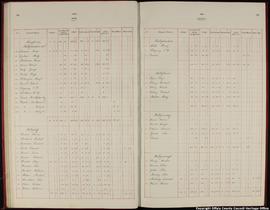
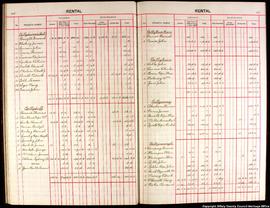
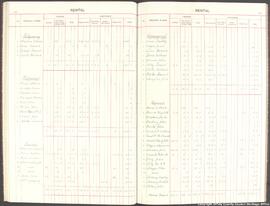
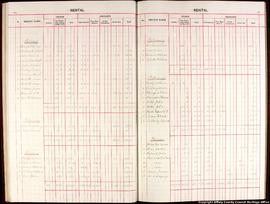
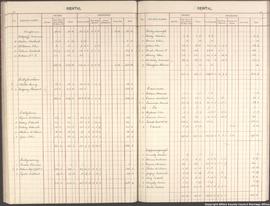
              Annual report and rental for year end June 1868, containing details of the finances of the estate, and developments inn drainage, land improvement, waste farms, tillage, woods and plantations. Main drains were completed at Meelaghans and Ballinvally, and 'thoro' drains were completed at Ballyknockan, Ballymooney and Killurin. All the drainage schemes were entered into a competition offered by the Royal Agricultural Society of Ireland for best drained land. Discusses farming and the merits of various types of fertilizer: Dublin manure, woolen rags or bone-dust. Also reports on the construction of a movable 'Russian Village', as seen at the Paris Exhibition in 1867, for easily housing labourers as they move around to work on various parts of the estate.

              Reports that a new building yard has been acquired next to the house of the architect, Thomas Mallinson, in Geashill Village, and also that a new machinery shed has been constructed to house the steam-engine, the threshing mill and other implements. In relation to repairs to tenants' houses, the report outlines there is much yet to be done, but that Lord Digby has won the gold medal from the RASI for repairs in the best manner for the greatest number of houses in Leinster. He was also awarded a bronze medal at the Paris Exhibition of 1867 for models of cottages exhibited.

              Discussing the general condition of the estate, Trench notes that the 'slight stains of Fenianism have been washed away by time and people now look at it as a thing of the past.' He also notes the death of the 3rd Earl of Rosse, the Lord Lieutenant of King's County, 'celebrated for his monster telescope and scientific acquirements.' Appendix contains a copy letter from Thomas Mallinson, Geashill architect, to T. W. Trench, reporting on a visit to London to inspect the manufacture and use of concrete to build houses. Declines to recommend concrete-built houses for the Geashill estate due to the expense and the varied character of the houses.